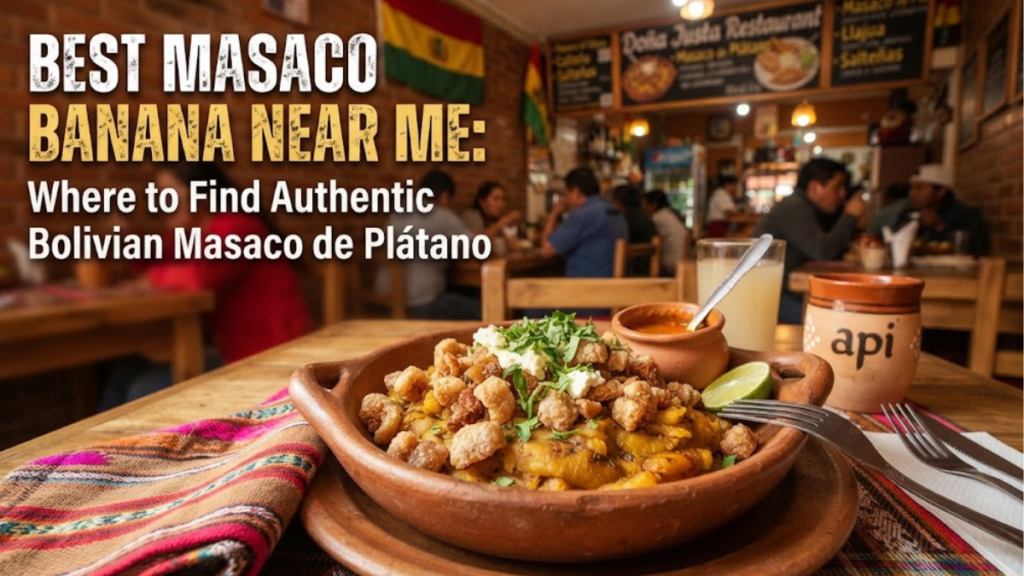

There are foods that taste good, and then there are foods that tell you where they came from. Masaco de plátano belongs firmly in the second group. Warm mashed plantain, savoury charque or pork, and creamy cheese come together in a rustic dish that feels deeply connected to eastern Bolivia.
If you are searching for the best masaco banana near me, there is one thing worth knowing before you start driving around: this is not a common everyday dish outside Bolivian communities. It is especially associated with Santa Cruz and the eastern lowlands, where masaco is found in traditional eateries, cafés, bakeries, markets and family kitchens.
The good news? Once you know what authentic masaco should look and taste like, finding a worthwhile plate becomes much easier. This guide covers the best documented places to look, what to order, how to recognise a properly made version, and how to make it at home.
The World’s Best Places to Try Masaco de Plátano
A quick reality check makes this section more useful: masaco is a regional Bolivian speciality rather than a globally standardised restaurant dish. I could verify strong examples in Bolivia, the United States and Spain, but I could not find reliable evidence of dedicated masaco restaurants in Asia. Rather than invent famous Asian restaurants simply to fill a list, the places below are the most credible documented stops I found.
Delicias de Oro — Santa Cruz de la Sierra, Bolivia
For a visitor who wants the classic Santa Cruz experience, Delicias de Oro is one of the clearest places to start. Its menu lists masaco de plátano maduro with a generous amount of cheese, alongside other traditional baked and snack-style foods such as cuñapé and sonso al palo.
The address is on Avenida Alemana between the 5th and 6th Ring, making it a practical stop when exploring Santa Cruz.
Las Delicias — Santa Cruz de la Sierra, Bolivia
Las Delicias has an unusually interesting connection with the dish. Recent Bolivian food coverage describes the salon de té as having prepared traditional masaco recipes for decades, with the family business tracing its history back 49 years. Its preparations include versions made with plantain, yuca, charque and pork crackling.
This is the kind of place food travellers should seek out when they want heritage rather than a modernised interpretation.
Restaurante El Hornero — Santa Cruz de la Sierra, Bolivia
El Hornero is another documented Santa Cruz stop. A Tripadvisor listing specifically shows masaco de plátano verde made with fried green plantain and either pork chicharrón or beef charque.
That combination is particularly useful for understanding the savoury side of masaco. Green plantain gives the mash a firmer, less sweet character than ripe plantain.
Chao Pescao — Santa Cruz de la Sierra, Bolivia
At Chao Pescao, a gastronomic market in Equipetrol, masaco de plátano dulce with fried cheese has appeared as part of a regional menu served with local dishes such as pacú.
It is an appealing option if you want to build a broader eastern-Bolivian meal around the masaco rather than eat it by itself.
Sibarita Restaurant — Arlington, Virginia, USA
Sibarita offers one of the more interesting American interpretations. The restaurant’s chef-owner Jorge Alborta developed a smaller, pupusa-style version of masaco, and the Washington Post highlighted its smooth texture and crisp exterior.
It is not exactly the same presentation you would receive in Santa Cruz, but that is precisely why it is worth trying: it shows how Bolivian cooks can adapt a traditional preparation without losing its character.
Cochabambino — Barcelona, Spain
Barcelona is another promising destination. Cochabambino, a Bolivian restaurant on Carrer de Trafalgar, has been documented serving masaco de plátano made with plantain and beef. Its menu changes, so checking availability before travelling is sensible.
For anyone in Europe craving a taste of Bolivia, this is one of the better-documented leads I found.
Best Restaurants in the USA for Masaco
Masaco is still a niche order in the United States, so I would not trust a generic search result that simply labels every Latin restaurant as a masaco specialist.
Sibarita — Arlington, Virginia
This is the strongest documented US restaurant example I found. Sibarita’s masaco has been described as a Bolivian-style pupusa made from yuca and cheese, with a crisp outside and soft interior. The restaurant was opened by chef-owner Jorge Alborta.
If you want the plantain-and-beef version specifically, ask before ordering because menus can change.
Miami — homemade Bolivian masaco is worth seeking out
Miami has a visible Bolivian community, but restaurant listings for masaco are inconsistent. One particularly notable example is Lili Melgar, a Bolivian from Santa Cruz who prepared green and ripe-plantain masaco in Miami after moving there.
That tells you something important: in Miami, authentic masaco may sometimes be easier to encounter through Bolivian community events, home cooks or special menus than through a permanent restaurant listing.
US tip: call ahead and ask specifically for masaco de plátano, not simply “masaco”. That distinction matters because masaco can also be made from yuca.
Best Places in the UK for Masaco
This is where a little honesty saves hungry readers a wasted journey.
I could not verify three or four established UK restaurants currently advertising masaco de plátano on reliable restaurant sources. That does not mean nobody in Britain makes it. It means the dish is sufficiently uncommon that claiming several “top-rated UK masaco restaurants” would be misleading.
London is the most sensible place to investigate because it has the UK’s deepest Latin American food scene. But availability should be confirmed directly with Bolivian restaurants, caterers and cultural events rather than assumed.
How to find it in the UK
Open Google Maps and search:
- “Bolivian restaurant near me”
- “masaco de plátano London”
- “Bolivian food London”
- “masaco de plátano UK”
- “Santa Cruz Bolivian food”
Then check recent menu photographs and call the restaurant. Ask whether the masaco is made with plátano verde, plátano maduro, cheese, charque or pork.
That final question can quickly separate a genuine regional preparation from a generic banana dish.
What Is Masaco Banana and What Is in It?
Masaco de plátano is a traditional dish from the lowland regions of Bolivia, particularly associated with Santa Cruz and Beni. It is made by frying or cooking plantain, then crushing it in a traditional wooden mortar called a tacú and mixing it with savoury ingredients.
There is no single universal recipe. Versions can use green, semi-ripe or ripe plantains and may include cheese, beef charque, pork chicharrón, oil or lard.
Main ingredients
- Plantains, green or ripe
- Cheese
- Beef charque or pork chicharrón
- Oil or lard
- Salt
A high-quality masaco should be moist and cohesive without becoming gluey. You should still notice the plantain, while the savoury meat or cheese gives it depth.
A poor version is usually either excessively oily, bland, dry or mashed into a completely uniform paste.
How to Make Masaco de Plátano at Home
You do not need a traditional tacú to make a good home version. A sturdy potato masher, mortar and pestle or heavy bowl can do the job.
Prep time: 15 minutes
Cook time: 30–40 minutes
Serves: 4
Step 1: Choose your plantains
For a savoury version, use green or just-turning-yellow plantains. Ripe plantains create a noticeably sweeter masaco.
Peel them carefully and cut them into thick slices. Avoid very thin pieces because they can become overly crisp before the centre softens.
Step 2: Fry the plantain
Heat a shallow layer of oil over medium heat. Fry the pieces until tender and lightly golden.
The goal is not dark, brittle plantain. You want pieces that are cooked enough to crush easily.
Step 3: Prepare the savoury filling
If using charque, cook it until tender, shred it finely and then fry it briefly so it develops a deeper savoury flavour.
Pork chicharrón works beautifully too. Keep some small pieces rather than grinding everything completely smooth; those little bites make the finished dish much more interesting.
Step 4: Mash while warm
Transfer the hot plantain to a sturdy bowl or mortar. Crush it while it is still warm.
This is where texture matters. Do not blitz it into baby-food consistency. Traditional masaco is a rustic mash, and small pieces are part of its charm. Traditional recipes specifically describe combining the cooked plantain, meat and cheese in a tacú.
Step 5: Add cheese and meat
Fold in grated or crumbled cheese and your charque or chicharrón.
Add a small amount of oil or melted lard if the mixture feels dry. Taste before adding salt because charque can already be quite salty.
Step 6: Shape and serve
Give the mixture a final gentle mash, then shape it into small rounds or serve it in rustic portions.
Serve immediately while warm. Santa Cruz’s municipal cultural guide specifically recommends masaco with coffee and notes that it can also accompany chocolate or chicha de maíz.
Two mistakes to avoid: using too much oil and over-mashing the plantain. Both can turn a beautifully rustic dish into a heavy, greasy paste.
For a first attempt, I like the balance of ripe plantain, mild cheese and a modest amount of crisp pork. If you prefer something less sweet, green plantain with beef charque is the better route.
Frequently Asked Questions
Is masaco banana the same as masaco de plátano?
Yes, in searches the phrase “masaco banana” is often used in English to describe masaco de plátano, the Bolivian plantain-based preparation. It is different from a normal sweet banana dessert because savoury ingredients such as cheese, charque or pork are commonly added.
Where can I find authentic masaco de plátano near me?
Your best chance is a Bolivian restaurant, especially one specialising in Santa Cruz or eastern-Bolivian cuisine. Search Google Maps for “masaco de plátano” and “Bolivian restaurant”, then call before visiting because the dish may be prepared only on certain days.
Is masaco made with green or ripe plantain?
Both are used. The Santa Cruz municipal recipe uses ripe plantains with cheese, while other traditional versions use green plantain with charque or pork.
What does masaco de plátano taste like?
It depends on the plantain and filling. Ripe plantain gives a gentle sweetness, while green plantain is starchier and more savoury; cheese adds richness and charque or pork brings salty, meaty flavour.
Can I make masaco without a tacú?
Absolutely. A heavy mortar and pestle, potato masher or sturdy bowl can work. The traditional tacú gives the dish its characteristic rustic texture, but you can reproduce the basic technique without owning one.
What should I eat with masaco de plátano?
Coffee is a classic pairing in Santa Cruz, while chocolate and chicha de maíz are also documented accompaniments. For a savoury meal, try it alongside other eastern-Bolivian specialities rather than treating it like a dessert.
Final Thoughts
Finding authentic masaco outside Bolivia takes a little more digging than finding tacos, empanadas or ordinary plantain dishes. That scarcity is part of what makes it exciting. The strongest documented options I found are concentrated around Santa Cruz, with a few overseas examples such as Sibarita in Virginia and Cochabambino in Barcelona.
If you are hunting for the best masaco banana near me, look beyond the word “banana” and search for masaco de plátano. Ask what type of plantain is used, whether the dish contains charque, pork or cheese, and whether it is made fresh.
Once you get a properly prepared version—warm, rustic, savoury and slightly sweet—you will understand why this humble Bolivian dish has such a loyal following. And if your search comes up empty, make a batch at home, put the coffee on, and let your kitchen take a little trip to Santa Cruz.